Easy
For discovering the world, learning the systems and moving forward with less pressure, even without much experience in games.
A vision of its own, development guided by data, and a creator committed to building a commercially sustainable game.
The full game is already free to play in the browser, and there is a Windows desktop build. The PC version is the one being prepared for Steam; phone comes later, and the PC version is not cut down for it. There are five zones and ten bosses, in English and Spanish. It is built live, on Twitch and Kick. This page does not publish figures, a valuation or a round.
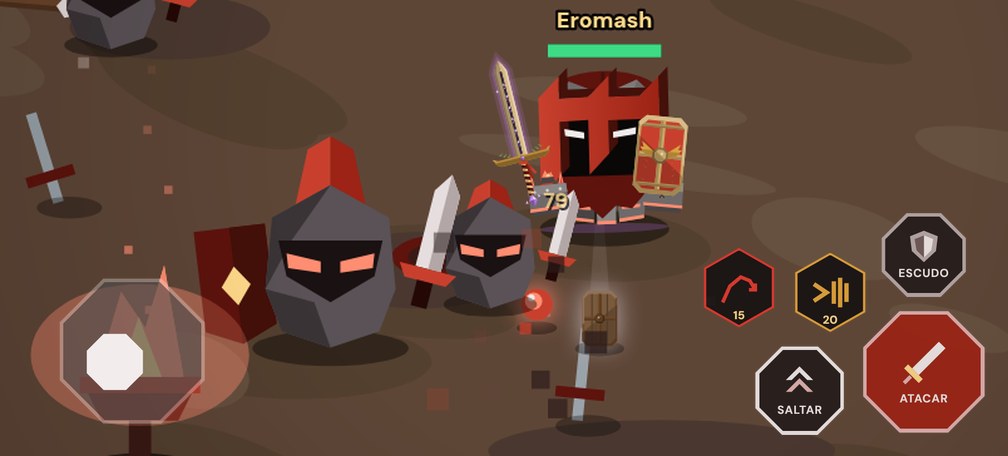
Eromash is a co-op action RPG for up to four players, set in a Viking world.
I am building it with a vision shaped by a lifetime of playing, and a development method that combines creative judgment, watching matches, and reading how players behave.
My experience as a player feeds the design. Matches and contact with other players help me question it and improve it.
Eromash is built to welcome people who want an accessible, relaxed run and people who like testing their skill. Each player can find a level of demand that matches their experience and what they want from a match.
For discovering the world, learning the systems and moving forward with less pressure, even without much experience in games.
A balance of access and difficulty that asks you to understand the game's systems and use them to advance.
For people who want demanding fights and enjoy sharpening their decisions, their strategy and their execution.
For people who want to play with a single life, where every mistake has consequences and surviving takes special care.
The aim is that clearing a challenge feels satisfying both for someone just starting and for someone trying to master the game. That range widens the players Eromash is for.
My own experience includes demanding challenges, such as the mythic difficulty bands of World of Warcraft. That perspective feeds the design of Eromash: I want depth for people trying to improve, and an accessible way in for people who would rather enjoy it with less pressure.
The game records, with notice to the player beforehand, what happens in each wave: duration, damage taken, skill use, dodges, potions and progress.
That lets me look into how long it takes to discover the mechanics, where unexpected obstacles show up, and which situations might be tied to people leaving. I compare those signals with matches and tester comments to understand their causes.
Watch when a mechanic is used for the first time, and what needs a clearer explanation.
Look into difficulty spikes and tell an intentional challenge from an unexpected obstacle.
Judge the pace of rewards against what players do and what they say.
Record what happens in matches.
Propose an explanation we can check.
Prepare a change and its automatic tests.
Play again, watch, and compare results.
I use difficulty formulas and analysis assisted by artificial intelligence to review the data, propose explanations and prepare changes with automatic tests. Design decisions and the approval of each version stay human.
The assistant helps read reports, frame diagnoses and prepare changes. Its proposals are treated as hypotheses. There is no AI changing the game live: every release needs a human review.
The first outside tests pointed to a possible difficulty spike at wave 7. From that observation I prepared an adjustment to the opening stretch in a day, with an automatic test to check that values outside that stretch stayed put.
The first sample is small. The next round of tests will look at whether the change improves the progression and whether players find the experience clearer, fairer and more compelling. The result is still waiting to be validated.
The value of this method is spotting problems early, steering development time, and checking which improvements justify more investment.
The commercial opportunity is turning that learning into an experience players value, recommend and want to return to. To judge that potential, development has to sit next to signs of demand, clear costs and goals that can be checked.
Today the full game stays free in the browser. How the Steam version will be offered is not decided yet: this page does not set a price or promise a sale.
Eromash's growth vision includes new classes, new game modes and a story mode.
Widen the ways to choose how you play and take part in the co-op.
Explore other ways to enjoy the combat and share the challenge.
Make room for a narrative adventure inside the world of Eromash.
Each addition will have its own scope and budget. Its priority will be set by player interest, what it adds to the experience, and what it costs to produce. The aim is a solid base, and a game that grows by decisions that have a reason.
I am Alejandro Vecchio, Argentine, 27, and I live in Denmark. I moved to Europe in 2021 and today I fund development with my job in a logistics warehouse.
Outside that shift, I spend my time designing, building and testing Eromash.
My experience as a player feeds the vision of the project; tests and contact with other players help me question it and improve it.
I am looking for a partner who brings capital and commercial experience, to widen my capacity to develop and take Eromash toward its launch.
The contribution would make it possible to spend more time on the project and cover production and launch needs, according to the scope we agree.
I propose working with a defined budget, milestones that can be checked, and transparent follow-up: what we build, what we learned, and which results justify the next step.
Direct contact with Alejandro Vecchio